 On 13
June 1923, Captain E.G.. King, Commander Submarine Division Three (later Fleet
Admiral and Commander in Chief, U.S. Fleet, during WW II), suggested to the
Secretary of the Navy (Bureau of Navigation) that a distinguishing device for
qualified submariners be adopted. He submitted a pen-and-ink sketch of his own
showing a shield mounted on the beam-ends of a submarine, with dolphins forward
of, and abaft, the conning tower. The suggestion was strongly endorsed by
Commander Submarine Division Atlantic. Over the next several months the Bureau
of Navigation (now known as BuPers) solicited additional designs from several
sources. Some combined a submarine with a shark motif. Others showed submarines
and dolphins, and still others used a shield design. A Philadelphia firm, which
had done work for the Navy in the field of Naval Academy class rings, was
approached by the Bureau of Navigation with the request that it design a
suitable badge. The firm submitted two designs, and these were combined into a
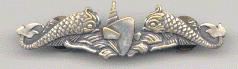
single design. This design was executed in bas-relief in clay. It was a bow view
of a submarine, proceeding on the surface, with bow planes rigged for diving,
flanked by dolphins in a horizontal position with their heads resting on the
upper edge of the bow planes. Today a similar design is used: a dolphin fish
flanking the bow and conning tower of a submarine. On March 20, 1924, the Chief
of the Bureau of Navigation recommended to the Secretary of the Navy that the
design be adopted. Theodore Roosevelt, Jr., Acting Secretary of the Navy,
accepted the recommendation on March 1924.
On 13
June 1923, Captain E.G.. King, Commander Submarine Division Three (later Fleet
Admiral and Commander in Chief, U.S. Fleet, during WW II), suggested to the
Secretary of the Navy (Bureau of Navigation) that a distinguishing device for
qualified submariners be adopted. He submitted a pen-and-ink sketch of his own
showing a shield mounted on the beam-ends of a submarine, with dolphins forward
of, and abaft, the conning tower. The suggestion was strongly endorsed by
Commander Submarine Division Atlantic. Over the next several months the Bureau
of Navigation (now known as BuPers) solicited additional designs from several
sources. Some combined a submarine with a shark motif. Others showed submarines
and dolphins, and still others used a shield design. A Philadelphia firm, which
had done work for the Navy in the field of Naval Academy class rings, was
approached by the Bureau of Navigation with the request that it design a
suitable badge. The firm submitted two designs, and these were combined into a
single design. This design was executed in bas-relief in clay. It was a bow view
of a submarine, proceeding on the surface, with bow planes rigged for diving,
flanked by dolphins in a horizontal position with their heads resting on the
upper edge of the bow planes. Today a similar design is used: a dolphin fish
flanking the bow and conning tower of a submarine. On March 20, 1924, the Chief
of the Bureau of Navigation recommended to the Secretary of the Navy that the
design be adopted. Theodore Roosevelt, Jr., Acting Secretary of the Navy,
accepted the recommendation on March 1924.